How to benchmark delivery performance
Most ecommerce brands know when their delivery is broken. Customer complaints spike, reviews mention late parcels, the ops team starts fielding calls. The problem is visible by then. The work of benchmarking is catching the deterioration before it becomes a problem, and understanding whether your delivery performance is genuinely good or just good enough to avoid complaints.

Yasmin Cohen
0
min read
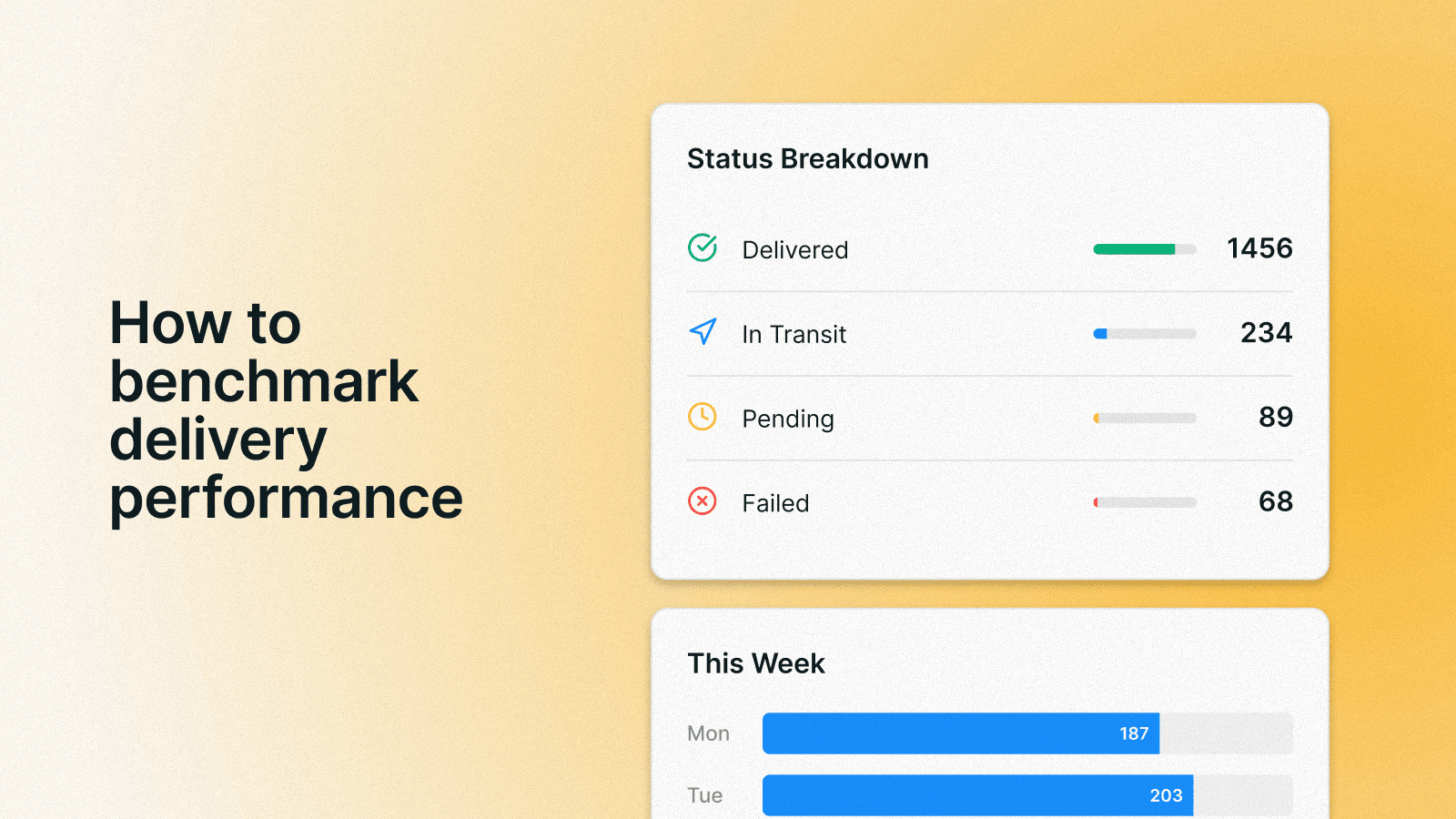
How to Benchmark Delivery Performance
Most ecommerce brands know when their delivery is broken. Customer complaints spike, reviews mention late parcels, the ops team starts fielding calls. The problem is visible by then. The work of benchmarking is catching the deterioration before it becomes a problem, and understanding whether your delivery performance is genuinely good or just good enough to avoid complaints.
Benchmarking delivery performance means comparing your metrics against a standard. That standard might be industry norms, your own historical performance, or the performance your carrier has contractually committed to. All three are useful. None of them tells the full picture on its own.
What to benchmark and against what
The metrics worth benchmarking are the same ones worth tracking in the first place: on-time delivery rate, first-attempt delivery success, cost per parcel, damage and loss rates, and customer complaint rate.
For each of these, you need a comparison point. Internal benchmarks, your own performance over time, are the most accessible and often the most actionable. If your on-time rate was 97% in January and it's 93% in March, something has changed. That trend matters regardless of what the industry average is.
External benchmarks are harder to get hold of because most carriers don't publish granular performance data. Industry reports, sector-specific surveys, and carrier RFP processes are the main sources. As a rough orientation: on-time delivery rates above 98% represent strong performance for most ecommerce categories. First-attempt success above 92% is solid. Damage rates above 1% start to become commercially significant.
Contractual benchmarks are the third type, and often the most overlooked. Most carrier contracts include service level commitments. Many brands sign them without building a process to measure whether they're being met. If your carrier has committed to 97% on-time delivery and you're seeing 91%, that's not just a performance issue. It's a commercial one.
How to use delivery data to improve ops
Data without action is just reporting. The point of tracking delivery performance is to identify where the operation is leaking, and fix it.
The most useful analytical move is segmentation. Aggregate metrics hide problems. A 95% on-time rate sounds reasonable until you segment by region and find that performance in the North East is running at 88%. Or you segment by parcel type and find that larger items are failing at twice the rate of standard parcels.
Common segments worth cutting delivery data by: geography (region, postcode area), parcel size and weight, delivery type (standard, next-day, nominated day), time of year, and carrier or depot if you're using multiple.
Once you've identified where performance is weakest, the next question is why. Late deliveries can stem from carrier capacity issues, routing inefficiency, address data quality problems, or customer availability. Each has a different fix. Diagnosing the root cause before acting saves a lot of time and prevents the common mistake of switching carriers to solve a problem that isn't actually the carrier's fault.
Address data quality is a good example. A meaningful proportion of failed deliveries across the industry are caused by incomplete or inaccurate addresses submitted at checkout. If your first-attempt rate is low, it's worth checking how much of that is downstream of bad address capture before assuming the carrier is underperforming.
How to spot carrier underperformance
Carrier underperformance isn't always obvious. Carriers have an incentive to present their performance data in the most favourable light, and the metrics they report don't always match the experience your customers are having.
A few signals worth watching. First, a gap between carrier-reported on-time rates and your customer complaint rate. If the carrier says 96% on-time but your complaint volume around delivery is high, the carrier's measurement methodology is probably doing some work you should understand.
Second, performance degradation at specific times of year without a corresponding communication from the carrier. Peak season volume increases are predictable. A carrier that doesn't proactively manage capacity and communicate constraints during busy periods is one that will underperform when it matters most.
Third, damage and loss rates that are hard to get clear data on. Some carriers make it straightforward to track claims and outcomes. Others make it difficult, which has the effect of obscuring the true rate. If you're having to chase for claims data, that's a signal worth taking seriously.
Fourth, a mismatch between promised and actual delivery windows communicated to your customers. This one shows up in reviews more than anywhere else. Customers who were told a specific day and received a vague window, or no update at all, will say so publicly.
How often to review carrier performance
The right review cadence depends on your volume and your risk tolerance, but a rough framework is useful.
Weekly: Track the core operational metrics. On-time rate, first-attempt rate, complaint volume. At this frequency you're looking for anomalies and early warning signs, not trends.
Monthly: Review performance against benchmarks and against the previous period. Look at segmented data. Identify any patterns that weren't visible in weekly snapshots. This is the right cadence for operational conversations with your carrier account manager.
Quarterly: Review the carrier relationship more broadly. Are SLAs being met? Has performance improved, held steady, or declined over the quarter? Is the carrier investing in the areas that matter to your business, technology, sustainability, capacity? Quarterly is also the right time to assess whether the commercial terms still reflect the operational reality.
Annually: Full strategic review. Benchmark against the market, not just your own history. Run an RFP if the relationship isn't working or if you want to pressure-test the market. Annual reviews create the conditions to make proactive decisions rather than reactive ones.
The brands that review delivery performance on a structured cadence tend to catch problems earlier, have more productive carrier relationships, and make better decisions about when to stay and when to move. The ones that review it only when something goes wrong tend to make those decisions under pressure, which rarely produces the best outcome.
HIVED gives every brand on the network access to real-time delivery data and transparent performance reporting. If you want visibility that actually helps you run a better operation, [get in touch].



CAREERS
Shape the future of logistics
We are hiring across our business. Get in touch today to see if HIVED could be the right fit for you.

" height="18px" id="WXhVeA1oH" transform="translate(4.16 3)" width="15.680039999999998px"/></svg>)
" height="18px" id="B9Ck5Ljyr" transform="translate(3 3)" width="18px"/></svg>)
" height="18px" id="v2_jQqFYe" transform="translate(3 3)" width="18px"/></svg>)