How to reduce delivery costs without hurting CX
Delivery costs are under scrutiny at most ecommerce brands right now. Carrier rates have increased, customer expectations around free delivery haven't moved, and the margin pressure in between is real. The instinct is to find ways to cut. The risk is cutting in ways that degrade the customer experience, which tends to cost more in the long run than the saving was worth.

Yasmin Cohen
0
min read
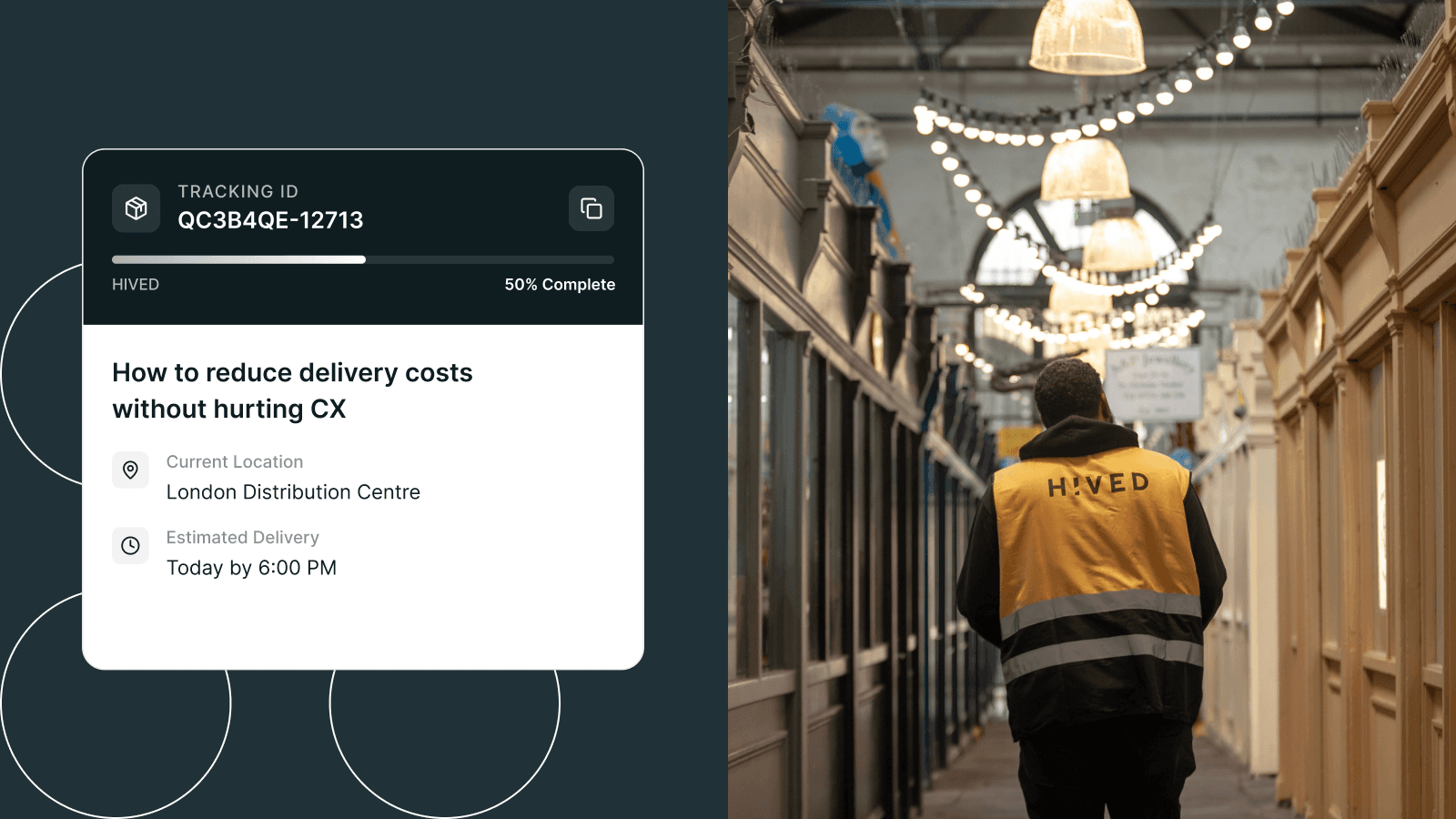
How to Reduce Delivery Costs Without Hurting CX
Delivery costs are under scrutiny at most ecommerce brands right now. Carrier rates have increased, customer expectations around free delivery haven't moved, and the margin pressure in between is real. The instinct is to find ways to cut. The risk is cutting in ways that degrade the customer experience, which tends to cost more in the long run than the saving was worth.
Reducing delivery costs sustainably means finding efficiencies in the operation rather than reducing the quality of what the customer receives. Those two things are not the same, and conflating them is where most cost-reduction efforts go wrong.
Understand your actual cost structure first
Before you can reduce delivery costs, you need to know what you're actually spending. For many brands, the headline per-parcel rate from their carrier is not the number that reflects reality. Fuel surcharges, peak surcharges, oversize fees, remote area charges, and redelivery costs all sit on top of the base rate, and they add up.
Pull a full cost analysis that includes every line item. Calculate your true average cost per parcel, including surcharges, and then segment it. Are certain product types consistently triggering oversize fees? Are certain postcodes carrying remote area charges that you're absorbing but not passing on? Is your redelivery rate high enough that failed first attempts are a meaningful cost line?
The segmentation usually reveals that cost is not evenly distributed. A small proportion of orders are often responsible for a disproportionate share of the cost. Identifying those and addressing them specifically is more efficient than trying to reduce the average across everything.
Packaging optimisation
Dimensional weight pricing means that carriers charge based on the size of a parcel as well as its actual weight. An oversized box with a small product inside is being priced as a large parcel. Packaging rationalisation, standardising on fewer box sizes that more closely match your actual product dimensions, can reduce per-parcel costs without any change to the carrier relationship or the customer experience.
This is one of the few cost reduction levers that also improves sustainability metrics. Smaller parcels mean less material, less void fill, and more efficient vehicle loading, which reduces per-parcel emissions as well as per-parcel cost.
The analysis is straightforward: map your current parcel dimensions against your carrier's dimensional weight pricing bands and identify where you're paying for space you're not using.
Delivery promise and service level mix
Not every customer needs or wants next-day delivery. Offering a range of service levels at checkout, with standard delivery as a free or low-cost option and faster services at a premium, lets customers self-select based on their actual need. This moves cost from the brand to the customer in cases where the customer is the one placing value on speed.
The commercial model here matters. Free next-day delivery for all orders is a cost that compounds at volume. Free standard delivery with next-day available for a fee is a different cost structure that gives customers choice without absorbing the premium on their behalf.
Brands that have moved from blanket free next-day to a tiered model typically find that most customers choose standard when there's a clear price differential, and the ones who pay for next-day are the ones who genuinely need it.
Reducing failed first attempts
Failed first attempts are a direct cost line. The carrier attempts a delivery, fails, and attempts again. You pay for both. At meaningful volumes, even a modest improvement in first-attempt success rate generates a measurable cost saving.
The levers for improving first-attempt rates are: better recipient communication before delivery (day-of notifications with an estimated window significantly increase availability), safe place and neighbour delivery options that remove the dependency on the recipient being home, and accurate address capture at checkout that reduces address-related failures.
Some of these are carrier capabilities. Some are within your control. Both are worth optimising.
Carrier consolidation
Brands that use multiple carriers to cover different regions or service levels often find that the operational overhead of managing multiple relationships outweighs the marginal commercial benefit of each individual carrier contract.
Consolidating onto a single carrier that covers your full geographic and service level requirements simplifies your operation, concentrates your volume to improve your commercial position, and reduces the integration and management overhead of running parallel carrier relationships.
The caveat is that carrier consolidation only makes sense if the single carrier can genuinely match the performance of the best performer in your current mix. Consolidating onto a carrier with weaker performance in certain regions to reduce management complexity is a false economy.
What not to cut
A few things that look like delivery cost levers but tend to create more cost than they save.
Removing tracking notifications reduces customer service contacts significantly. Brands that turn these off to reduce platform costs tend to see inbound query volumes increase by more than the saving justifies.
Downgrading packaging quality to reduce material costs can increase damage rates. The cost of a damaged parcel, including replacement, customer service, and reputational impact, is almost always higher than the packaging saving.
Switching to a cheaper carrier without a performance evaluation tends to produce lower costs and lower performance. The customer service and retention costs of worse delivery experience usually exceed the carrier saving within a few months.
HIVED has no fuel surcharges or peak surcharges, and our network is built for consistent first-attempt delivery performance. If you want to understand what your delivery could cost with us, [get in touch.]

CAREERS
Shape the future of logistics
We are hiring across our business. Get in touch today to see if HIVED could be the right fit for you.

" height="18px" id="WXhVeA1oH" transform="translate(4.16 3)" width="15.680039999999998px"/></svg>)
" height="18px" id="B9Ck5Ljyr" transform="translate(3 3)" width="18px"/></svg>)
" height="18px" id="v2_jQqFYe" transform="translate(3 3)" width="18px"/></svg>)