Key delivery KPIs every SMB should track
Most ecommerce brands have a clear view of their commercial metrics. Conversion rate, average order value, return rate, and customer acquisition cost. These numbers get reviewed weekly, sometimes daily.

Yasmin Cohen
0
min read
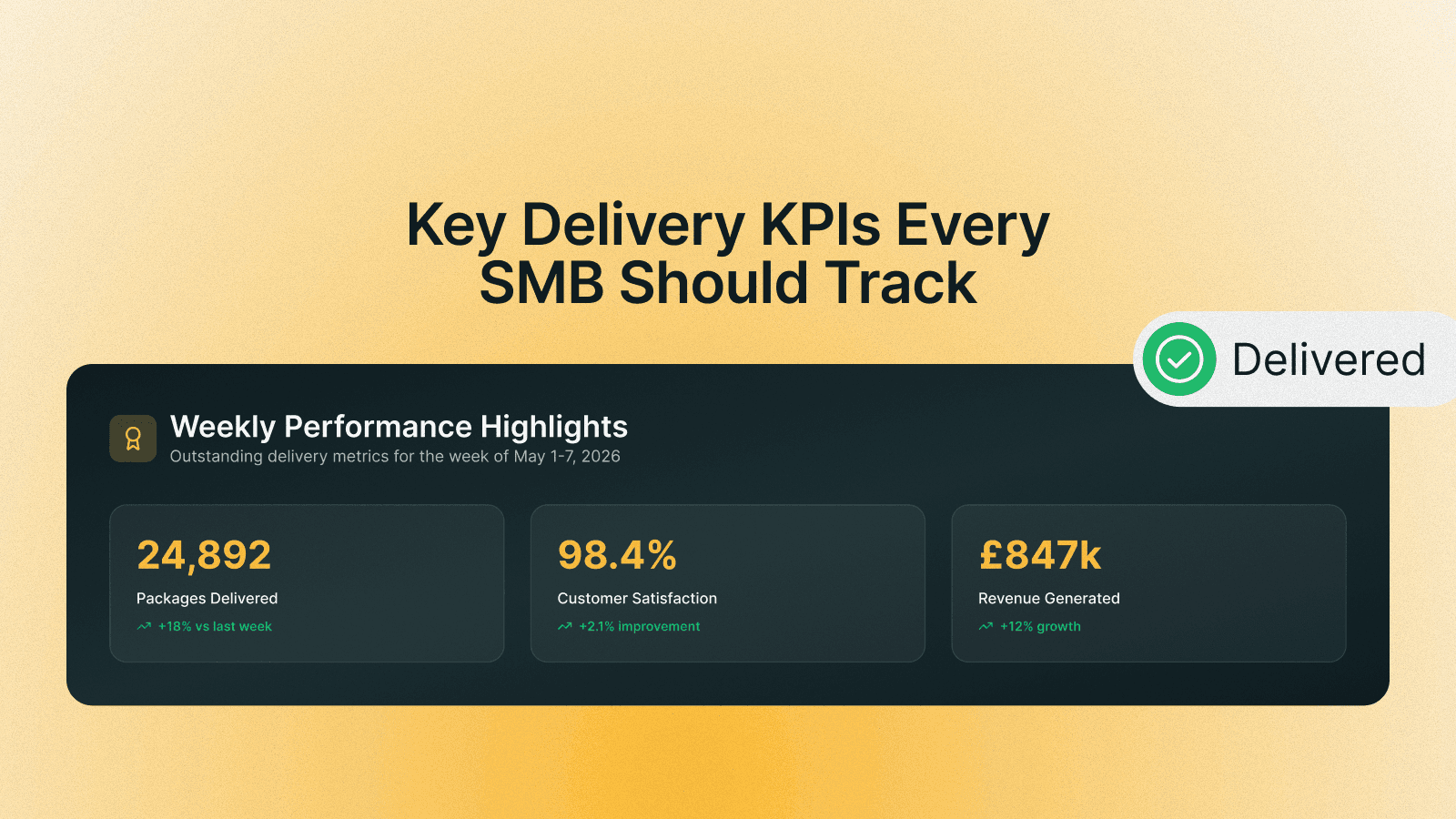
Key delivery KPIs every SMB should track
On-time delivery rate explained
First-attempt delivery success explained
Cost per parcel explained
Customer delivery complaints as a KPI
—
Key Delivery KPIs Every SMB Should Track
Most ecommerce brands have a clear view of their commercial metrics. Conversion rate, average order value, return rate, and customer acquisition cost. These numbers get reviewed weekly, sometimes daily.
Delivery metrics get less attention. They sit in a carrier portal, checked occasionally, usually only when something goes wrong. That is a problem because delivery performance directly and measurably affects the commercial metrics brands value most. Poor on-time rates drive customer service calls. Failed first attempts drive redelivery costs. A cheap cost per parcel that masks poor reliability proves neither economical nor beneficial for the brand.
Here are the four delivery KPIs that actually matter, what they measure, and why they are worth tracking properly.
On-time delivery rate
Not all on-time delivery rates measure the same thing. Some carriers measure performance against their internal windows, which can be broad. A parcel delivered on day three of a one-to-three-day window counts as on-time in their reporting, even if the customer was expecting it on day one. Others measure against the specific date communicated to the customer at checkout.
The latter matters for your brand. If a customer was told Wednesday and the parcel arrived Friday, that is late in the customer's eyes, no matter what the carrier says.
Track on-time delivery rate against customer-facing promises, not carrier SLAs. Aim for 98% or above. Anything below 95% affects customer service volumes and review scores.
First-attempt delivery success
First-attempt delivery rate is the percentage of deliveries completed on the first try, without a failed attempt, a missed delivery card, or a redelivery.
Failed first attempts are expensive in several ways simultaneously. There is the direct cost of a second delivery attempt. There are customer experience impacts: the missed delivery notification, the redelivery scheduling, and the additional wait. And there is the operational complexity of managing redelivery queues at scale, which compounds quickly for high-volume brands.
For most carriers, first-attempt delivery rates range from 85% to 95%. The variance is driven by address data quality, the flexibility of delivery windows, the availability of safe-place or neighbour delivery options, and the carrier's proactivity in communicating with the recipient before arrival.
A high first-attempt rate is one of the clearest signals of a well-run delivery operation. It reduces cost per parcel, reduces customer service contacts, and improves the end customer experience in one move.
Cost per parcel
Cost per parcel is the total delivery spend divided by the number of parcels shipped. It is the most straightforward delivery metric and also the one most likely to be optimised in isolation, creating problems elsewhere.
A lower cost per parcel is not always better. Carriers that compete primarily on price tend to compete less on reliability, technology, and service quality. The savings on the label are easily offset by higher customer service costs, more replacement shipments, and lower repeat purchase rates driven by poor delivery experience.
The more useful version of this metric is cost per successful delivery, which factors in failed attempts, redeliveries, and lost or damaged parcels. This metric gives a clearer picture of actual delivery costs to the business.
Track cost per parcel alongside on-time rate and first-attempt rate. A carrier that looks cheap on one metric but underperforms on the other two is usually more expensive overall once downstream effects are factored in.
Customer delivery complaints
Delivery complaints are a direct sign of delivery performance and are often underused.
Most brands track complaints in aggregate but do not segment by root cause. A "late delivery" and a "parcel damaged" complaint are both delivery complaints, but point to different problems that require different fixes. Lumping them together hides the real issues.
Useful ways to track delivery complaints include: complaint rate as a percentage of orders shipped, breakdowns by type (late, damaged, lost, missed delivery), and volume by carrier or region if you use multiple carriers.
Benchmarking against industry norms is hard since most carriers do not publish this data. But tracking your own rate over time, and connecting it to carrier or operational changes, shows whether things are getting better or worse.
HIVED provides real-time delivery visibility and performance data to every brand on the network. If you want cleaner data and more reliable delivery, [talk to us].



CAREERS
Shape the future of logistics
We are hiring across our business. Get in touch today to see if HIVED could be the right fit for you.

" height="18px" id="WXhVeA1oH" transform="translate(4.16 3)" width="15.680039999999998px"/></svg>)
" height="18px" id="B9Ck5Ljyr" transform="translate(3 3)" width="18px"/></svg>)
" height="18px" id="v2_jQqFYe" transform="translate(3 3)" width="18px"/></svg>)