What is sustainable delivery?
Why ecommerce delivery emissions matter Scope 3 emissions explained for retailers How last-mile delivery impacts carbon footprint Electric vehicles in last-mile delivery How to talk about sustainable delivery credibly

Yasmin Cohen
0
min read

What is sustainable delivery?
Why ecommerce delivery emissions matter
Scope 3 emissions explained for retailers
How last-mile delivery impacts carbon footprint
Electric vehicles in last-mile delivery
How to talk about sustainable delivery credibly
—
What Is Sustainable Delivery?
Sustainability has become one of the most talked-about topics in ecommerce. It has also become one of the most misunderstood. Brands make commitments, add green badges to their checkout pages, and assume that covers it. But customers are becoming more informed, regulators are becoming more active, and the gap between genuine action and performative messaging is growing harder to hide.
Sustainable delivery is one of the most concrete places ecommerce brands can make a real difference. It is also one of the easiest places to get the communication wrong.
Why ecommerce delivery emissions matter
Delivery is a significant source of carbon emissions for ecommerce businesses, and last-mile delivery specifically is the most emissions-intensive part of the supply chain. The final leg of a parcel's journey, from a depot to a customer's door, typically accounts for more than 50% of total supply chain emissions.
As ecommerce has grown, so has the cumulative impact. More parcels, more vans, more diesel. For brands that have set sustainability targets or made public commitments to customers, delivery is not a footnote. It is one of the biggest levers available.
Scope 3 emissions explained for retailers
Most brands are familiar with Scope 1 emissions (direct emissions from owned sources) and Scope 2 emissions (indirect emissions from purchased energy). Scope 3 is everything else: the emissions that occur in your value chain but outside your direct control.
For ecommerce brands, Scope 3 typically includes manufacturing, packaging, customer returns, and delivery. Because brands do not own the delivery infrastructure, the emissions sit in Scope 3. But they still count towards a brand's overall footprint, and increasingly, they are being scrutinised by investors, regulators, and customers alike.
Choosing a delivery carrier with a lower emissions profile is one of the most direct ways a brand can reduce its Scope 3 footprint. It does not require product redesign or supplier renegotiation. It requires a procurement decision.
How last-mile delivery impacts carbon footprint
Last-mile delivery is hard to decarbonise for a structural reason: it involves a large number of vehicles making many short, stop-start trips across dense urban and suburban areas. That operating pattern is inefficient for combustion engines, which perform better at sustained speeds.
Electric vehicles are better suited to that stop-start pattern. They do not have the same efficiency drop-off, produce zero direct emissions, and are increasingly cost-competitive as the technology matures and charging infrastructure improves.
Route optimisation also plays a role. Smarter routing means fewer miles driven, which means lower emissions regardless of vehicle type. For carriers investing in both technology and fleet, the combination of electric vehicles and intelligent routing delivers a meaningful reduction in per-parcel emissions.
Electric vehicles in last-mile delivery
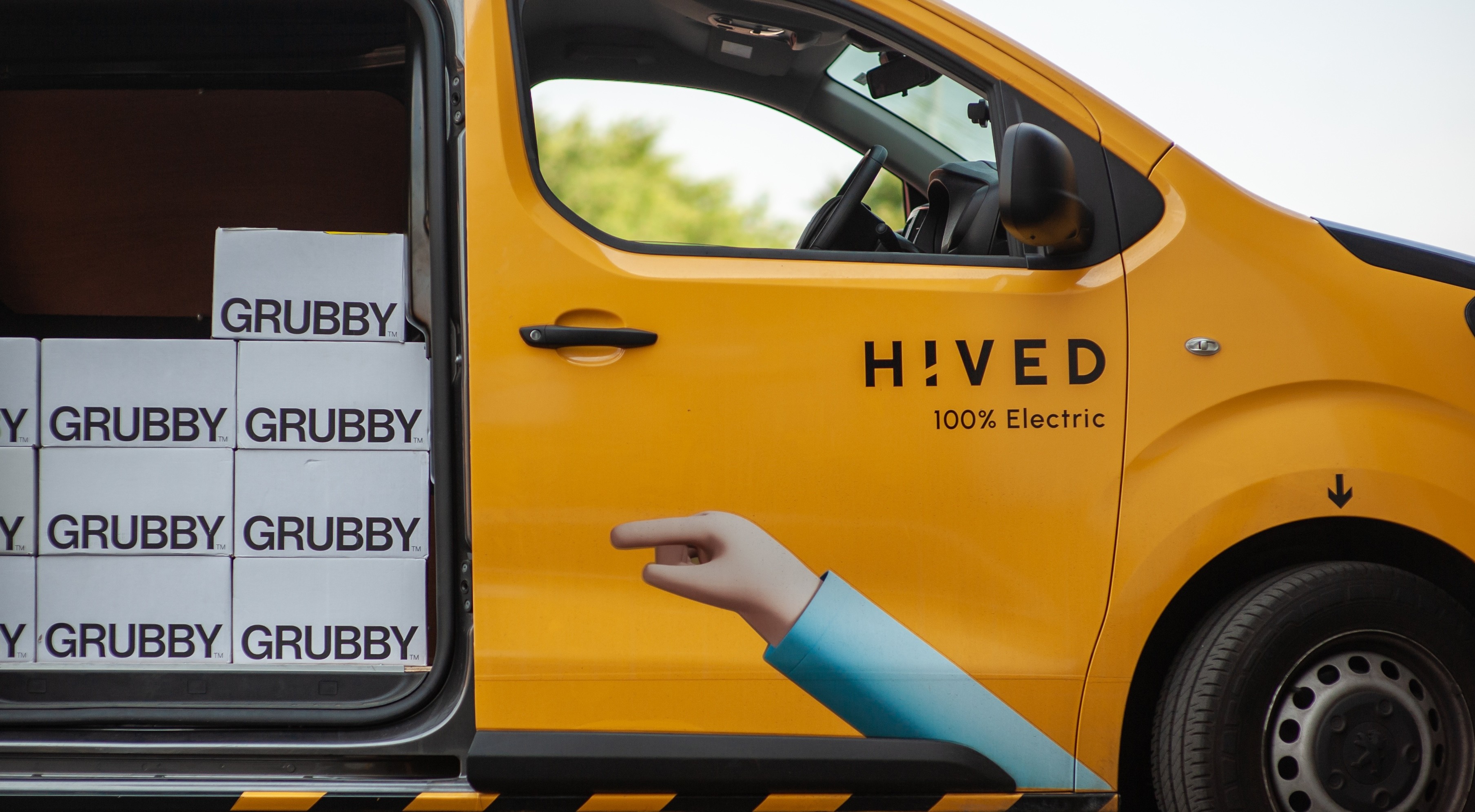
The business case for electric fleets in last-mile delivery is no longer theoretical. Van-sized electric vehicles are commercially viable for most urban and suburban delivery routes. Larger electric vehicles, including electric heavy goods vehicles, are entering the market and beginning to reshape the middle-mile part of the network. HIVED already operates 44-tonne electric HGVs as part of its UK network, producing 76% less CO2e per parcel compared to diesel equivalents.
For ecommerce brands evaluating carriers, fleet composition is a practical signal of genuine sustainability commitment. A carrier operating a fully electric fleet will produce zero direct emissions at the tailpipe, per parcel. A carrier with a mixed or primarily diesel fleet is not, regardless of what their marketing says.
The distinction matters because it affects the emissions figure you can actually report. If your carrier can provide verified CO2e data per parcel, you can use that figure in your own sustainability reporting. If they cannot, or will not, that tells you something, too.
How to talk about sustainable delivery credibly
The reputational risk of greenwashing is real and growing. Customers who feel misled by sustainability claims do not just stop buying. They talk about it. And regulators in the UK and EU are increasingly scrutinising environmental claims made in advertising and on product pages.
Credible, sustainable delivery communication follows a few principles. First, be specific. "We are committed to reducing our carbon footprint" means nothing. "Our delivery partner produces 76% less CO2e per parcel than diesel equivalents" means something. Second, be verifiable. Cite the methodology, the data source, or the certification. Third, do not overclaim. If your fleet is partially electric or your carbon reduction is offset-based rather than operational, say so accurately.
The brands that communicate sustainability well tend to have the operational substance to back it up. The communication is not the hard part. Getting the operations right is.
HIVED and sustainable delivery
HIVED operates a fully electric delivery network across the UK, including 44-tonne electric HGVs, and produces 76% less CO2e per parcel compared to diesel. For brands that have made sustainability commitments and need the delivery operations to match, [get in touch.]

CAREERS
Shape the future of logistics
We are hiring across our business. Get in touch today to see if HIVED could be the right fit for you.

" height="18px" id="WXhVeA1oH" transform="translate(4.16 3)" width="15.680039999999998px"/></svg>)
" height="18px" id="B9Ck5Ljyr" transform="translate(3 3)" width="18px"/></svg>)
" height="18px" id="v2_jQqFYe" transform="translate(3 3)" width="18px"/></svg>)